
Democracy in America (250)

Saturday was America's 250th birthday, or semiquincentennial. There was a party in DC that I didn't follow and I don't care about all the talk it generated, for good or bad, as it all regarded our current president and the over-the-top opinions that surround him. That's not to say I do not think 250 years is incredibly cool. It is, and I'm stoked our republic has made it this long. May it survive 250 more.
As for this blog I didn't really have anything planned in advance. It's too infrequently at the forefront of my mind these days. Though, there's plenty I could've written about. The Spirit of '76, the zeitgeist of the moment. Or the revolutionary generation, the leaders who made it happen. If you've never read it I will always recommend one book above all on this era, Founding Brothers by Joseph Ellis. Through six short stories you get to know the men, the situations, the passions and disagreements, of many of the most prominent Founders: Washington, (John and Abigail) Adams, Jefferson, Madison, Hamilton, and Burr among them. The book isn't all that long but you get to learn quite a bit about the messy politics that have governed this country since its inception and how it was yet built to last.
.jpg)
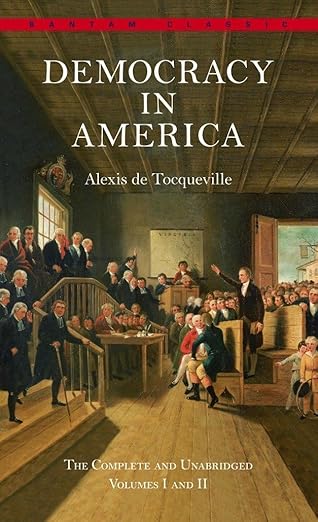
While at my parents mountain house in the lead-up to Independence Day, I noticed they had a copy of Alexis de Tocqueville's Democracy in America. Published in two volumes in 1835 and 1840, the Frenchman was relaying what he'd learned about America to his home country, and really Europe more broadly. In so many ways this book mirrors Polybius (see also this post) from two millennia prior, in trying to explain the Roman system of government to then conquered poleis of Greece. Here Tocqueville took a deep dive not only into the American constitution but its people as well, in an effort to explain the new, thriving democratic nation. (Note that this book was researched and published during the reign of the last French King, in the <50 year restoration following the French Revolution and Napoleon.) The world has not, to this day, seen a more important work explaining why America is special and different from the rest of the world. Much, though certainly not all, of what he wrote still applies, nearly 200 years later.
I read a big chunk of this book probably 20 years ago and remember being shocking at times for its remarkably observant analysis, in particular of Americans, the people. (For all its wit it's also admittedly a difficult read from cover to cover, but I digress). What has lingered in my mind about Democracy in America is what I wanted to rediscover. After a bit of skimming and some more detailed reading over the past couple weeks I've again worked through volume one and want to share my favorite findings of this seemingly timeless book.
Tocqueville starts with a little geography and history and focuses in large part on New England. Here, most of all, the people that first inhabited the English colonies were middle class and came to forge their own path, much of the time for religious reasons, fleeing persecution in England, etc. The world these people built was inherently anti-aristocratic. (And different from Virginia and the rest of the south I may add.) People were equals and a democratic spirit reigned from the very beginning. This part, under 'Political Consequences of the Social State of the Anglo-Americans' (Vol. 1, Part 1, Chap. 3) stood out immediately, as what he describes could be people and politics today:
'There is indeed a manly and legitimate passion for equality which rouses in all men a desire to be strong and respected. This passion tends to elevate the little man to the rank of the great. But the human heart also nourishes a debased taste for equality, which leads the weak to want to drag the strong down to their level and which induces men to prefer equality in servitude to inequality to freedom. It is not that peoples with a democratic social state naturally scorn freedom; on the contrary, they have an instinctive taste for it. But freedom is not the chief and continual object of their desires; it is with quick and sudden impulses, but if they miss their mark they resign themselves to their disappointment; but nothing will satisfy them without equality, and they would rather die than lose it.
On the other hand, when the citizens are all more or less equal, it becomes difficult to defend their freedom from the encroachments of power. No one among them being any longer strong enough to struggle alone with success, only the combination of the forces of all is able to guarantee liberty. But such a combination is not always forthcoming.'
Afterward he briefly mentions the concept of the sovereignty of the people in the United States and starts at the city and state level before explaining the mechanisms of the federal government. Then he arrives at the meat of the matter, how the people govern, through political parties, through freedom of the press, and through political association, for starters. Here a comparison between the United States and Europe is used. Europeans, he says, use political association in only a military sense, they gather their forces and they act. Americans, however, join with like-minded people to show their strength in numbers, to weaken the majority whom they oppose, and to convince others to join their side. I think this aspect of American politics remains largely true, in least in some sectors, though I fear too many politically active Americans now act like the Europeans Tocqueville describes (end of Vol. 1, Part 2, Chapter 4):
'The main aim of these associations being to act and not to talk, to fight and not to convince, there is naturally nothing civilian about their organization, and indeed military ways and maxims are introduced therein; one also finds them centralizing control of their forces as much as they can and placing the whole authority in very few hands.
Members of these associations answer to a word of command like soldiers on active service; they profess the dogma of passive obedience, or rather, by the single act of uniting, have made a complete sacrifice of their judgement and free will; hence within associations, there often prevails a tyranny more intolerant than that exercised over society in the name of the government they attack.'
He goes on to break down many long-standing American political hallmarks. Of how the people we elect to power are rarely our best and brightest (Vol. 1, Part 2, Chap. 5):
'When I arrived in the United States I discovered with astonishment that good qualities were common among the governed but rare among the rulers. In our day it is a constant fact that the most outstanding Americans are seldom summoned to public office, and it must be recognized that this tendency has increased as democracy has gone beyond its previous limits. It is clear that during the last fifty years the race of American statesmen has strangely shrunk.'
Or of how our laws are frequently poorly constructed, but regardless our system is durable (Vol. 1, Part 2, Chap. 6):
'An aristocracy is infinitely more skillful in the science of legislation than democracy can ever be. Being master of itself, it is not subject to transitory impulses; it has far sighted plans and knows how to let them mature until the favorable opportunity offers. An aristocracy moves forward intelligently; it knows how to make the collective force of all its laws converge on one point at one time.
A democracy is not like that; its laws are almost always defective or untimely.
Therefore the measures of democracy are more imperfect than those of an aristocracy; it often unintentionally works against itself; but its aim is more beneficial.
Suppose a society so organized by nature or by its constitution that it can tolerate the passing effect of bad laws and can without disaster await the result of the general tendency of its laws, and in such a case you will appreciate that democratic government, for all its faults, is yet the best suited of all to make society prosper.
That is just what does happen in the United States; I here repeat what I have described elsewhere: the great privilege of the Americans is to be able to make retrievable mistakes.'
Of how, even in the 1830s (and before), it could be a challenge to get people to participate politically. Of course it's eminently worth it. Do you think this section (Vol. 1, Part 2, Chap. 6) sounds familiar to 21st (not only 19th) century audiences?:
'I am not asserting it to be an easy matter to teach all men to make use of political rights; I only say that when that can happen, the results are important.
And I would add that if ever there was a century in which such an attempt should be made, that century is ours.
Do you not see that religions are growing weak and that the conception of the sanctity of rights is vanishing? Do you not see that mores are changing and that the moral conception of rights is being obliterated with them?
Do you not notice how on all sides beliefs are giving way to arguments, and feelings to calculations? If amid this universal collapse you do not succeed in linking the idea of rights to personal interest, which provides the only stable point in the human heart, what other means will be left to you to govern the world, if not fear?'
I'll make this next passage, from the same chapter, the last quote. I've rarely read something I agree with more.
'It cannot be repeated too often: nothing is more fertile in marvels than the art of being free, but nothing is harder than freedom's apprenticeship. The same is not true of despotism. Despotism often presents itself as the repairer of all the ills suffered, the support of just rights, defender of the oppressed, and founder of order. Peoples are lulled to sleep by the temporary prosperity it engenders, and when they do wake up, they are wretched. But liberty is generally born in stormy weather, growing with difficulty amid civil discords, and only when it is already old does one see the blessings it has brought.'
There's a whole lot more too. Tocqueville has a long chapter (Vol. 1, Part 2, Chap. 10) breaking down the three races of the burgeoning United States. He predicts that European-Americans are bound to dominate the whole continent. That African-Americans, as a result of slavery, are bound for long term racial discord even if the practice is abolished. And that Native Americans are bound to be pushed aside and or eliminated entirely. So far he's on the money and predicted the rest of the 19th century at minimum. I was most shocked reading, in the Volume 1 Conclusion, by the author calling out a potential coming collision-course between the United States and Russia, the most quickly growing country in the Old World. So, somehow, he foresaw the second half of the 20th century as well.
Two quick thoughts, then I'll be done with this marathon post. One, this is a book very much still insightful and worth reading. Two, it's incredible how much, in some ways, things never change. American politics has forever been messy, frustrating, and too-often flirtatious with singular rule. But! The system continues to chug along surprisingly effectively. We are, after all, having many of the same fights today as they did in the 1830s (like on, for example, tariffs). Altogether this is actually fairly reassuring.


Comments